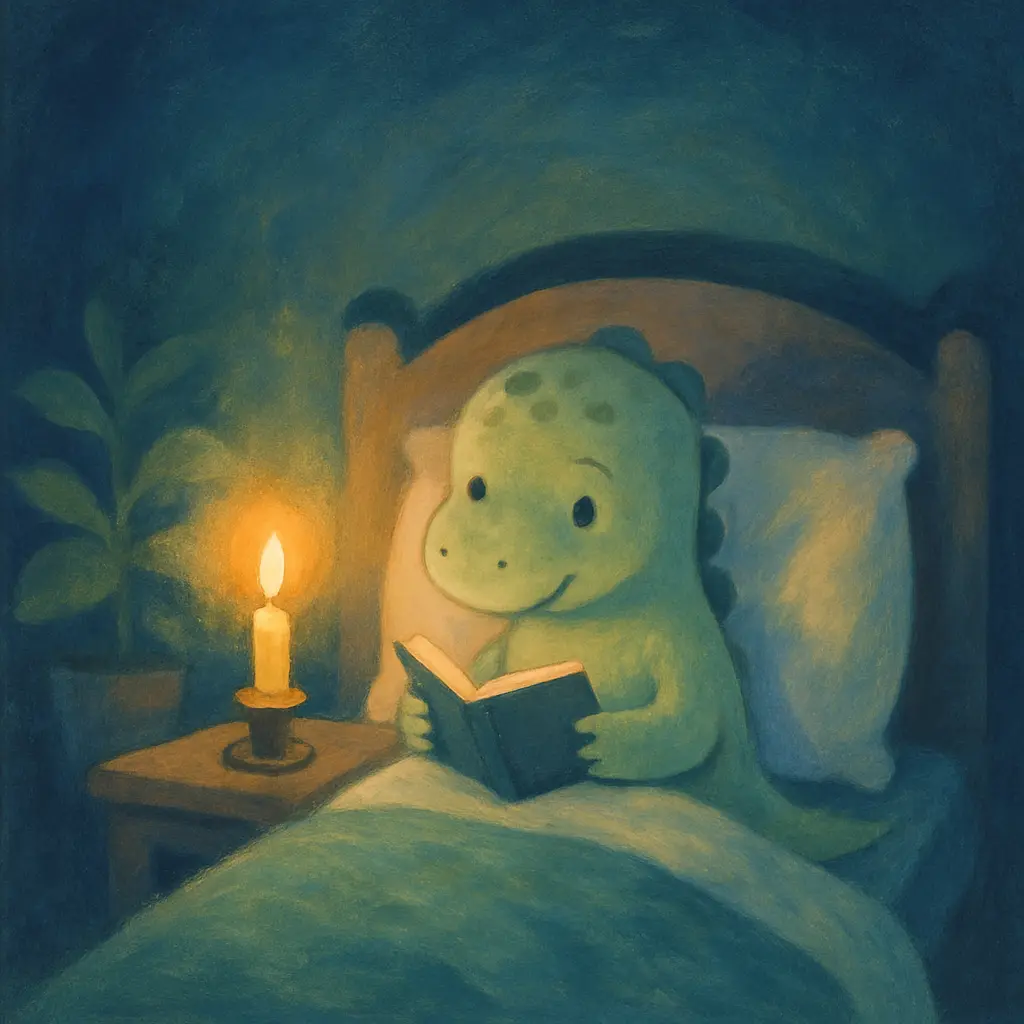
Pistache was a green dinosaur, not very tall, with a notebook and a pencil always hanging round his neck. That morning he arrived at his strawberry patch and stood there open-mouthed.
Last night he had counted twenty fine red strawberries. This morning there were none left. Not one. Only leaves and little holes in the soil.
“InvestigationA search to find out the truth, by gathering clues one at a time.,” wrote Pistache at the very top of the page. Then he underlined it twice, because an investigation underlined twice is always more serious.
First he went all the way round the patch on all fours, very slowly, holding his pencil like a magnifying glass, which is no help at all but lends an investigationA search to find out the truth, by gathering clues one at a time. a great deal of seriousness.
First clue: footprintsThe marks left by paws or feet in soft ground. in the soft earth. Very small ones, with four toes. Pistache measured them with his pencil. “Far too small for me,” he noted.
He went to see Croquette the hedgehog, who has exactly four toes. “It wasn't me,” she said. “I don't like strawberries, they stick to my spines.” And that was true, everybody knew it.
Second clue: something was shining between two leaves. A feather. Grey, with a white tip. Pistache tucked it into his notebook and went to see the magpies.
He also noted that the leaves were flattened towards the west, and that three stems had been broken at the same height, as though the thief were not very tall but had come in numbers.
The magpies protested very loudly, all at once, which is their way of saying hello. “We were at the bell tower all night!” Pistache believed them, because they had indeed been heard from the bell tower all night.
He sat down in the grass and read his notes again. FootprintsThe marks left by paws or feet in soft ground. too small. A grey feather. And, he only noticed it now, a smell of pond mudThe soft grey sludge that settles at the bottom of ponds and rivers..
So Pistache went to the pond. And there, on the bank, he found the twentieth strawberry, half eaten, beside a family of ducks who were very busy pretending to swim.
So he went back to the patch, sat down exactly where the stems were broken, and looked in the direction the leaves were flattened. Westwards. Which is to say, precisely, towards the pond.
“Hello,” said Pistache. The ducklings looked the other way. The mother duck sighed. “They were hungry. The farm ran out of corn three days ago.”
Pistache looked at the five ducklings, then at his notebook, then at the five ducklings again. He closed the notebook. “I have a better idea than a punishment,” he said.
The youngest duckling, the one still with fluff on his head, waddled up to Pistache, looked at his notebook for a while, and then said very quietly: “They were really good. Especially the big one at the end of the row.” Which, in an investigationA search to find out the truth, by gathering clues one at a time., counts as a full confession.
The following spring there were two patches in Pistache's garden: a big one for him, and a small one right at the edge, on purpose, facing the pond. Finding the culprit was half the job. The good half was understanding why.
The end, sweet dreams.