
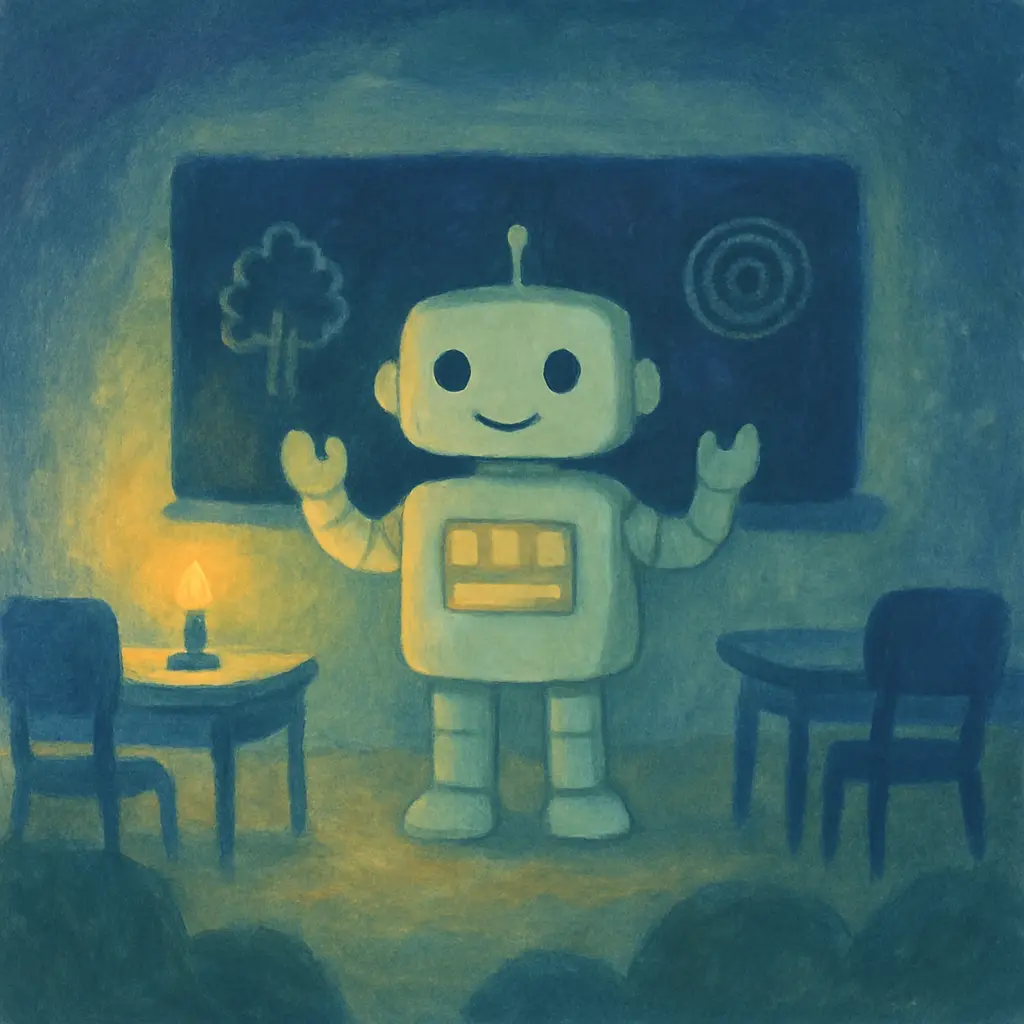
On the first Monday of term there was a new pupil in Mrs Ferrand's class. He was one metre twenty tall, he was grey, and he had two wheels instead of feet. His name was BIP-7.
“BIP-7 is coming to learn with us for a month,” explained the teacher. “He already knows a great many things. He is here to learn the ones you cannot find in books.”
BIP-7 raised one arm and said, very loudly: “HELLO. I AM DELIGHTED TO MAKE YOUR ACQUAINTANCE.” The whole class jumped. One boy dropped his pencil case.
BIP-7 put his bag in locker number twelve, which he measured first to check that the bag would fit, then settled at the back of the class, in the spot where he was in the fewest people's way.
“That's too loud,” said Lina, from the second row. BIP-7 noted something in his programThe list of instructions a robot or computer follows to know what to do.. The next day he said exactly the same sentence, but so quietly that nobody heard it.
“That's too quiet,” said Lina. BIP-7 noted again. On the third day he found the right volumeHow strong a sound is: the greater the volume, the louder you hear it., but he said his sentence to the window, because the window was the first object in the room in his scanning order.
It carried on like that all week. BIP-7 always said the same sentence, complete, perfectly pronounced: “HELLO. I AM DELIGHTED TO MAKE YOUR ACQUAINTANCE.” And every time, something was wrong.
On Thursday he tried saying hello while moving, which produced a sentence cut in half by the noise of his wheels. On Friday morning he said it backwards, starting from the end, which did not help in the slightest.
On Friday he rolled up to the teacher's desk. “I do not understand. My sentence is correct. My volumeHow strong a sound is: the greater the volume, the louder you hear it. is correct. Why does it not work?”
Mrs Ferrand thought about it. Then she called Lina over. “Lina, how do you say hello?” Lina shrugged. “Well... it depends.”
“It depends on what?” asked BIP-7, and for the first time all his lights began flashing at once. “On who it is,” said Lina. “On whether you saw them yesterday. On whether they look happy or not.”
“So there is no rule at all?” asked BIP-7, and his voice rose a little, which had never happened before. “There is one,” said Mrs Ferrand. “Look at the person before you speak. The rest comes on its own.”
BIP-7 stayed completely still for eleven seconds, which is a very long time for a robot. Then he deleted his sentence. The whole sentence. Four hundred languages and one single formula, wiped in an instant.
The following Monday he came in, stopped beside the second row and said simply: “Hi Lina.” Then he rolled over to the boy with the pencil case and said: “Is your pencil case all right now?”
He started with the easy ones: the people he had seen the day before, the ones already smiling. He kept for last the ones looking at the floor, because he had calculated that with them you have to try harder.
The class burst out laughing, and BIP-7 recorded the sound of the laughter in a fileA box in a machine's memory, where information is stored so it can be found again. he named “successful”. It had taken him a week to understand that saying hello is not pronouncing a word: it is showing that you have noticed someone.
The end, sweet dreams.